Hardest Italian Sounds for English Speakers: Why Double Consonants Come First
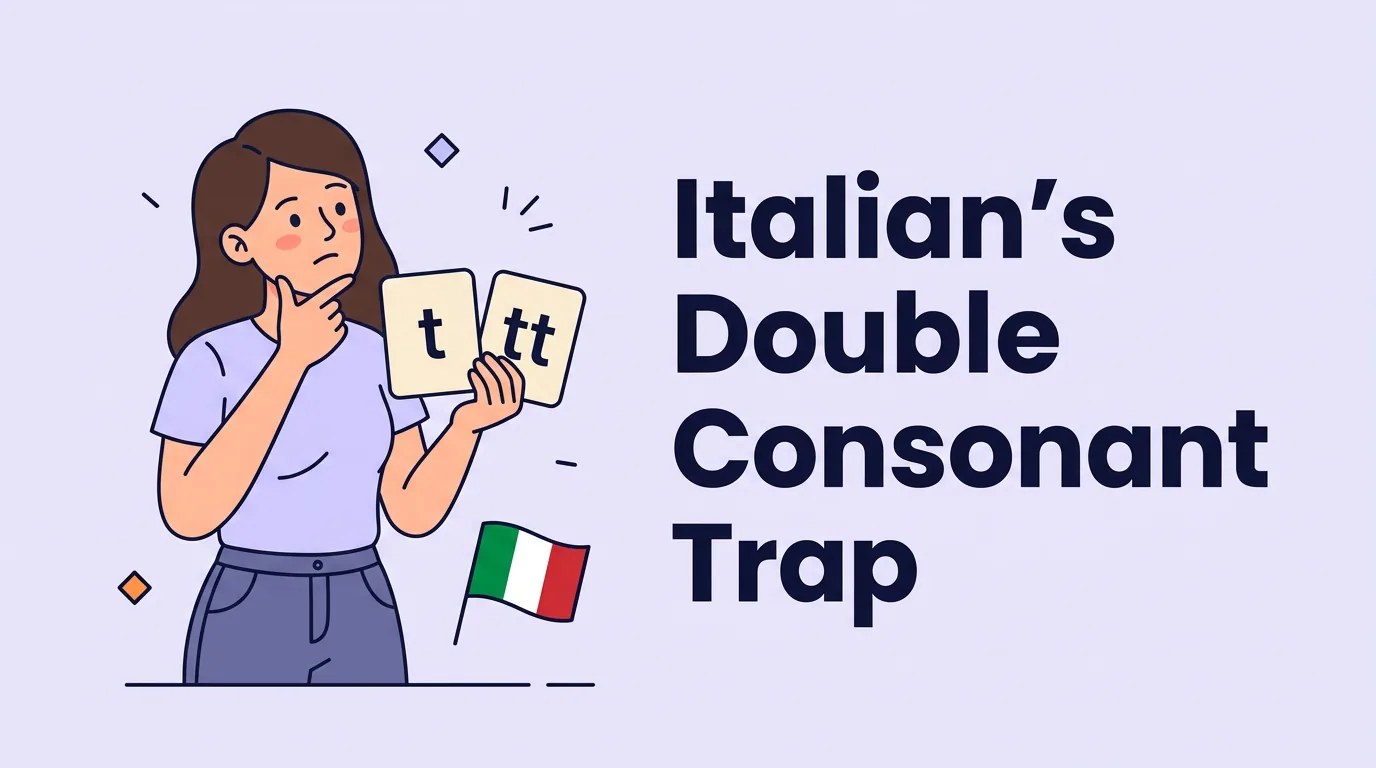
Short answer: In our own Italian deck data, the hardest sound contrast for English speakers is not the rolled r. It is consonant length, the difference between a single consonant and a doubled one, as in vale and valle. That length is involved in 118 of the 222 word pairs in our Italian minimal-pairs deck.
This post explains what we counted, how we ranked it, and what to do about it. It is the first in a set of four: we ran the same analysis on Spanish, French, and German too.
What is the hardest sound in Italian for English speakers?
Most learners guess the rolled r. We did too, until we sorted the deck.
We built a simple rules-based score for our minimal-pairs decks. A contrast scores high when English has no category for it, because you cannot reliably hear a difference your first language never trained you to notice.
Consonant length scores highest, and it is also the most common contrast in the Italian deck.
How did we rank the Italian sound pairs?
Our Italian minimal-pairs deck has 222 word pairs. Each pair is two real words that sound almost the same.
We scored every pair by the type of contrast between the two words, using the IPA transcription on each card. This is our own ordering, calibrated for a native English ear. It is not a lab study, and we are not claiming one.
The counts, though, you can check yourself. Here is how the 222 pairs sort:
- 118 pairs: involve a long or doubled consonant
- 54 pairs: distinct consonants that English hears easily, such as questo and chiesto
- 19 pairs: vowel quality, such as pulizia and polizia
- 10 pairs: palatal sounds, such as paia and paglia
- 9 pairs: sibilants and fricatives, such as scienza and senza
- 6 pairs each: stop voicing and segment presence
Over half the deck, 118 of 222, involves consonant length. The rolled r does not get a category of its own here, because Italian’s rolled r mostly shows up as a doubled one, as in corro and coro.
What is a doubled consonant in Italian?
A doubled consonant, also called a geminate, is a consonant held noticeably longer than a single one. Italian spells it with a double letter, and it changes the word.
English also has double letters, as in letter and rabbit. In English they are only spelling. The consonant is not held any longer, and holding it longer would never turn one word into another.
That is why most English speakers never learn to hear it.
Which Italian words differ only by a double consonant?
Here are eight pairs from our deck where the doubled consonant is the only difference between the two words:
- vale (worth) and valle (valley)
- coro (choir) and corro (I run)
- pena (penalty, pain) and penna (pen)
- camino (chimney) and cammino (walk)
- note (notes) and notte (night)
- eco (echo) and ecco (here)
- copie (copies) and coppie (pairs)
- accade (it happens) and accadde (it happened)
Some of these are more than a spelling detail. Say camino when you mean cammino and a listener may hear a fireplace where you meant a walk.
Do all 118 pairs differ only by length?
No, and we want to be precise about this. Our “length” category counts any pair where one word has a doubled consonant, even if the pair also differs in another sound.
Of the 118, only 14 differ by nothing but the doubled consonant. The other 104 pair a doubled consonant with a second difference, as in baio and ballo or meglio and mezzo.
We still think the finding holds. A doubled consonant sits on one side of more than half of the deck’s pairs, so it is a skill you will need again and again.
Why can’t English speakers hear Italian double consonants?
This is our reasoning, not a research finding: your ear sorts sounds into the categories your first language uses. English has no category for a held consonant, so the difference gets filed under “same sound.”
You can know every word in a sentence and still say the wrong one. Your ear never flagged the difference, so your mouth had no target to aim at.
How do you learn to hear and say double consonants?
Vocabulary will not fix this. Training the ear on the contrast will. Here is a method you can try this week.
- Pick one pair. Start with vale and valle.
- Say the single version first. Keep it short and light.
- Hold the doubled version. For consonants like l, m, n, r, and s, keep the sound going for a full beat before moving on.
- Feel the closure on stops. For consonants like p, t, and c, the hold is a short silence before the release. You will feel your mouth stay shut a moment longer.
- Listen and choose. Play a recording of the pair and try to tell which is which with your eyes closed. If you cannot yet, that is exactly the gap worth drilling.
Our minimal-pairs decks are built around step five: you hear a word, then choose between the two candidates. You will find that format in the Italian Pronunciation Bundle, alongside the IPA for every word so you can see exactly where the length falls.
For a wider look at Italian sounds and stress, our guide to how to pronounce Italian words is a good companion.
Is this only an Italian problem?
No. Every language has its own version of the skill your ear skipped. We ran the same ranking on three other decks, and each one has a different top contrast:
- Spanish: the Spanish deck has the largest share of pairs an English ear already hears easily, and its top category is the palatal sounds, like the ñ.
- French: the French deck leans on nasal vowels and rounded front vowels, which together involve 74 of 257 pairs.
- German: the German deck has long versus short sounds in 53 of 211 pairs.
Different sounds, same pattern: the contrasts your first language does not use are the ones you cannot hear on your own.
The bottom line
The hardest Italian sound for English speakers, by our own deck data, is a length, not a letter. Consonant length involves 118 of 222 pairs, and only 14 of those are pure single-versus-double contrasts.
Pick one pair, hold the doubled consonant, and let your ear catch up.
Want more practical, no-nonsense language-learning tips like this? Subscribe to Speakada Weekly for one practical email a week.