Hardest French Sounds for English Speakers: Nasal Vowels and Rounded Vowels
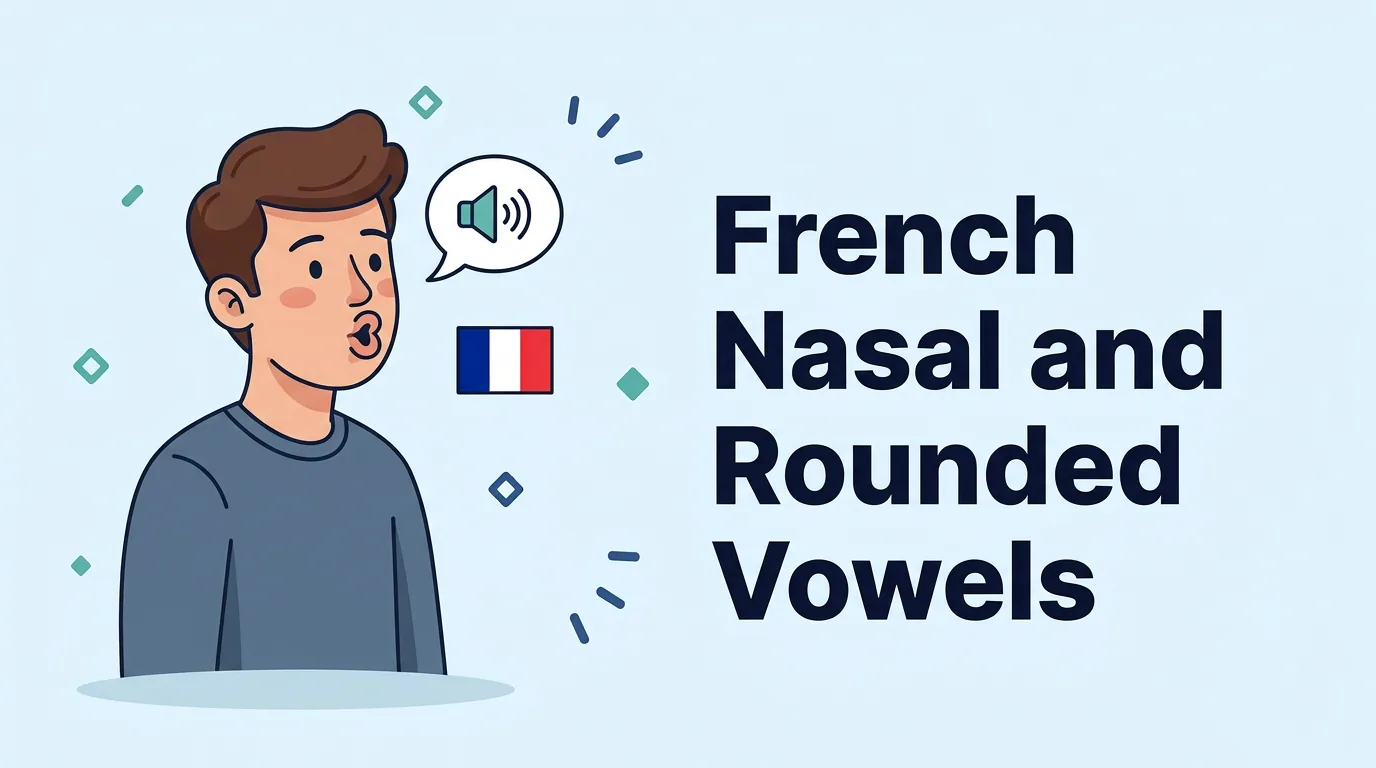
Short answer: In our own French deck data, the hardest sound contrasts for English speakers are nasal vowels and rounded front vowels. Together they involve 74 of the 257 word pairs in our French minimal-pairs deck: 39 nasal pairs and 35 rounded front vowel pairs.
English has neither sound, so an English ear has no ready category to hear them with. This post shows what each one is, with real pairs from the deck.
What are the hardest sounds in French for English speakers?
We ranked every pair in the deck with a rules-based score built for a native English ear. A contrast scores high when English has no category for it.
This is our own ordering, not a lab result. The counts are easy to check.
Here is how the 257 pairs sort:
- 135 pairs: distinct consonants that English hears easily, such as pont and ton
- 39 pairs: nasalization, such as grain and gris
- 35 pairs: front-rounded vowels, such as huit and bit
- 30 pairs: vowel quality
- 9 pairs: palatal sounds
- 5 pairs: sibilants and fricatives
- 3 pairs: stop voicing
- 1 pair: trill versus lateral
The two top categories, nasal and rounded front vowels, are the ones that make French sound like French.
What is a nasal vowel in French?
A nasal vowel is a vowel spoken with air flowing through the nose as well as the mouth. French has four in our deck, and they are not an oral vowel followed by an n.
In bien, you do not say a clear n at the end. The nasal quality is inside the vowel itself.
English speakers tend to add a hard n or ng at the end. That replaces the sound French actually uses.
Which French word pairs differ by a nasal vowel?
Here are pairs from our deck where nasal against oral, or one nasal against another, is the main difference:
- biais (means, way) and bien (well)
- saut (jump) and son (sound)
- enfin (finally) and afin (so that)
- comment (how) and commun (common)
- brun (brown) and brin (blade of grass)
The first three test whether you can hear a nasal vowel at all. The last two test whether you can tell one nasal vowel from another.
What is a front-rounded vowel?
A front-rounded vowel is made with your tongue forward, as in the vowel of ee, while your lips are rounded, as in oo. English does not have this combination.
The most famous one is the u in tu. Most English speakers say it as oo, which turns tu (you) into something closer to tout.
Here are pairs from the deck built around these vowels:
- mur (wall) and mer (sea)
- creux (hollow) and cru (raw)
- peu (little) and paix (peace)
- fut (he/she was) and fou (mad)
- sœur (sister) and sert (he/she serves)
The pair fut and fou is the clearest test of the tricky one: a rounded front vowel against a rounded back vowel.
How do you say the French u?
Here is a method you can try in a minute:
- Say “ee.” Notice where your tongue is, pressed forward and high.
- Keep your tongue exactly there. Do not let it move back.
- Round your lips as if you were about to say “oo.”
- Blow out the sound. What comes out is the French u.
If it slides back to “oo,” your tongue moved. Go back to step one.
Does our count mean these pairs are only nasal or only rounded?
No. Our nasal and rounded categories count any pair where one of these sounds is the main difference our rules detect. Some pairs differ in other ways too.
For example, mur and mer is a rounded vowel against an unrounded one. But saut and son pairs an oral vowel with a nasal one that also has a different vowel quality.
We still think the pattern holds, because these two families account for nearly three in ten of the pairs in the deck.
Which French sounds are easy for English speakers?
More than half of the deck. In our data, 135 of 257 pairs differ by consonants that both exist in English and are easy to tell apart, such as pont and ton.
That is good news for your study plan. You do not need to drill every pair with the same effort.
Spend most of your time on the pairs that involve a nasal or rounded vowel, and let the easy consonant pairs pass through quickly.
How should you practice these contrasts?
Train the ear first, then the mouth.
- Pick a pair. Start with biais and bien.
- Listen and choose. Hear a word and decide which of the two you heard. If you cannot yet, you have found the gap.
- Say each word aloud. Match what you hear, not what you see written.
- Come back to it. Spaced repetition returns the pairs you miss more often.
That is how our French Minimal Pairs Flashcards are built. The French Pronunciation Bundle adds the alphabet and IPA cards, so you can see which vowel each word uses.
For the fundamentals, our guide to how to pronounce French words covers the basics that these contrasts build on.
How does French compare to the other languages?
Each language we ranked has a different hardest contrast. Italian is the one where a length, the doubled consonant, comes first, and our Italian sound analysis shows it in 118 of 222 pairs.
German has a rounded-vowel family of its own, which we cover in the hardest German sounds for English speakers.
The bottom line
By our own deck data, French is hard for an English ear because of two things English does not do: sending air through the nose while saying a vowel, and rounding the lips with the tongue forward.
Learn to hear them in pairs, and the rest of the deck gets easier.
Want more practical, no-nonsense language-learning tips like this? Subscribe to Speakada Weekly for one practical email a week.