Hardest German Sounds for English Speakers: Long Vowels and Umlauts
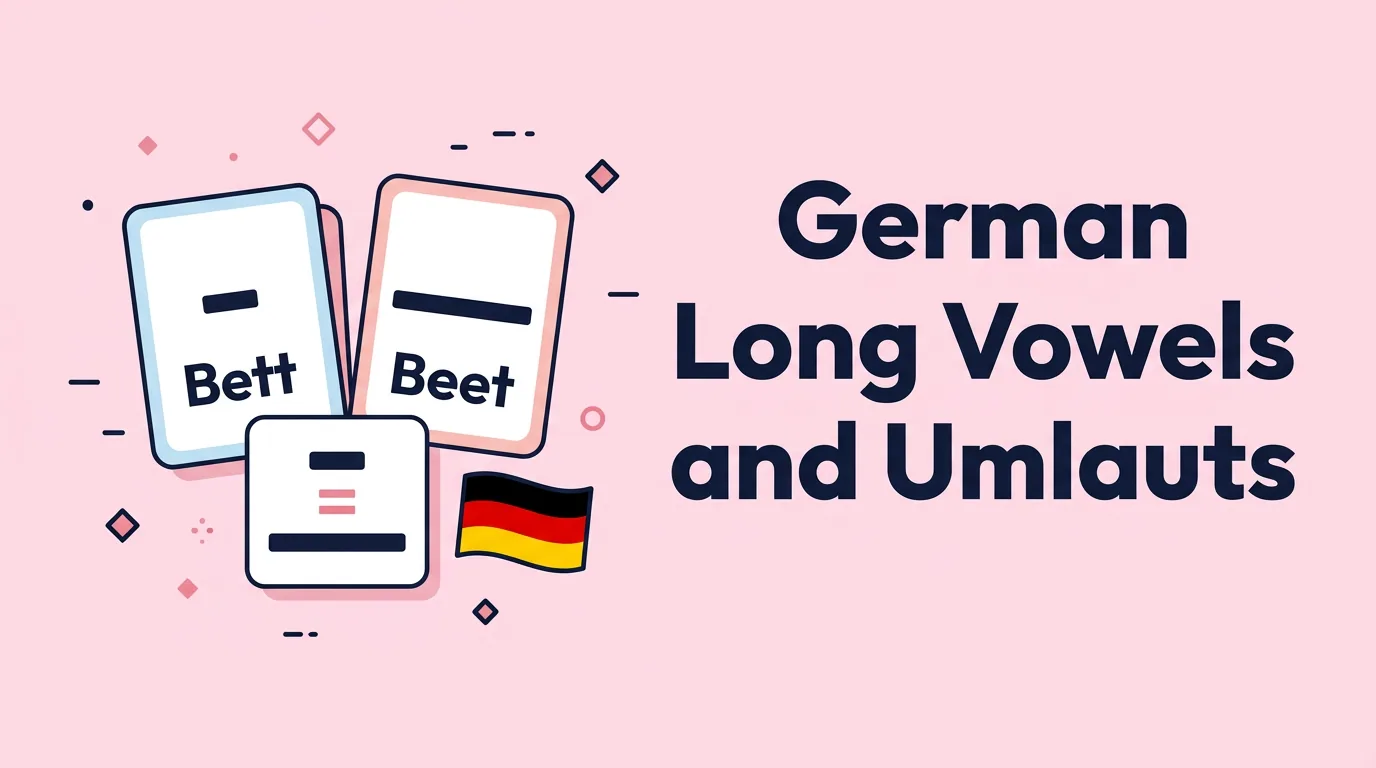
Short answer: In our own German deck data, the hardest sound contrasts for English speakers are long versus short sounds, which involve 53 of the 211 pairs in our German minimal-pairs deck, and the umlaut vowels ö and ü, which involve another 30. English uses neither difference to separate words, so an English ear tends to miss both.
Below is what we counted, what the difference sounds like, and how to drill it.
What are the hardest sounds in German for English speakers?
We ranked every pair in the deck with a rules-based score built for a native English ear. A contrast scores high when English has no category for it.
This is our own ordering, not a lab result. The counts are simple to check.
Here is how the 211 pairs sort:
- 86 pairs: distinct consonants that English hears easily, such as steht and spät
- 53 pairs: length, where one word has a long vowel or a doubled consonant, such as beten and Betten
- 30 pairs: front-rounded vowels, such as Hefe and Höfe
- 14 pairs: stop voicing, such as Pass and Bass
- 9 pairs: sibilants and fricatives
- 7 pairs: trill or liquid contrasts
- 6 pairs: a sound that appears or disappears
- 3 pairs: vowel quality, and 3 more that our scoring could not separate
Length involves about one pair in four. That is a lower share than in our Italian deck, where it involves more than half.
Why does vowel length matter in German?
In German, holding a vowel longer, or cutting it short, can turn one word into another. English has no such rule, so you will not have practiced listening for it.
The German alphabet gives you clues. A vowel is often long when it is followed by h, is doubled, or is spelled ie. A doubled consonant letter usually signals that the vowel before it is short.
Which German words differ by long versus short?
Here are pairs from our deck where a long vowel on one side is set against a short one:
- Bahn (train) and Bann (spell)
- beten (to pray) and Betten (beds)
- bieten (to offer) and bitten (to ask)
- kam (came) and Kamm (comb)
- lahm (lame) and Lamm (lamb)
- Staat (state) and Stadt (city)
- Ofen (oven) and offen (open)
Note that in several pairs the short vowel is not just shorter. In bieten and bitten, the IPA on the card shows a different vowel quality as well, so length and quality travel together.
That is why we say the length category involves these pairs. It does not mean each one is a pure length contrast.
How do you hear and say a long German vowel?
Try this on Bahn and Bann:
- Say Bann first. Keep the vowel short and crisp, and close the word quickly.
- Say Bahn. Hold the vowel steady for a full beat before the final n.
- Keep the vowel pure. Do not let it glide into a second sound, the way English vowels often do.
- Listen and choose. Hear one of the two words and pick which you heard.
If step four is a coin flip, you have found what to drill.
What are the German umlaut vowels ö and ü?
The umlaut vowels ö and ü are front-rounded vowels, made with the tongue forward and the lips rounded. English does not have them.
For ü, say “ee” and hold your tongue where it is, then round your lips as if to say “oo.” For ö, do the same starting from the vowel of “eh.”
English speakers tend to replace ü with “oo” and ö with a plain “uh.” Our deck has 30 pairs built on the difference.
Which German words differ by an umlaut vowel?
These pairs come straight from the deck:
- schon (already) and schön (beautiful)
- Bogen (bow) and Bögen (bows)
- liegen (to lie) and lügen (to tell a lie)
- kennen (to know) and können (can)
- Kiste (box) and Küste (coast)
- Hefe (yeast) and Höfe (courts)
Some of these matter beyond pronunciation. Say schon when you mean schön and you have changed the meaning of the sentence.
Which German sounds are easy for English speakers?
Many of them. In our data, 86 of 211 pairs differ by consonants that English also has and hears clearly, such as steht and spät.
A smaller group, 14 pairs, is about stop voicing, as in Pass and Bass. That one is worth a look, but it is a much smaller job than length or the umlauts.
The practical takeaway: put most of your listening time into long versus short, and into ö and ü.
How should you practice German minimal pairs?
Work in pairs, not in single words, and train the ear before the mouth.
- Choose one contrast. Start with either long versus short, or ü versus u.
- Listen and choose between the two words on each card.
- Say both aloud. Match what you hear, not what you see written.
- Come back to the misses. Spaced repetition brings the pairs you get wrong back more often.
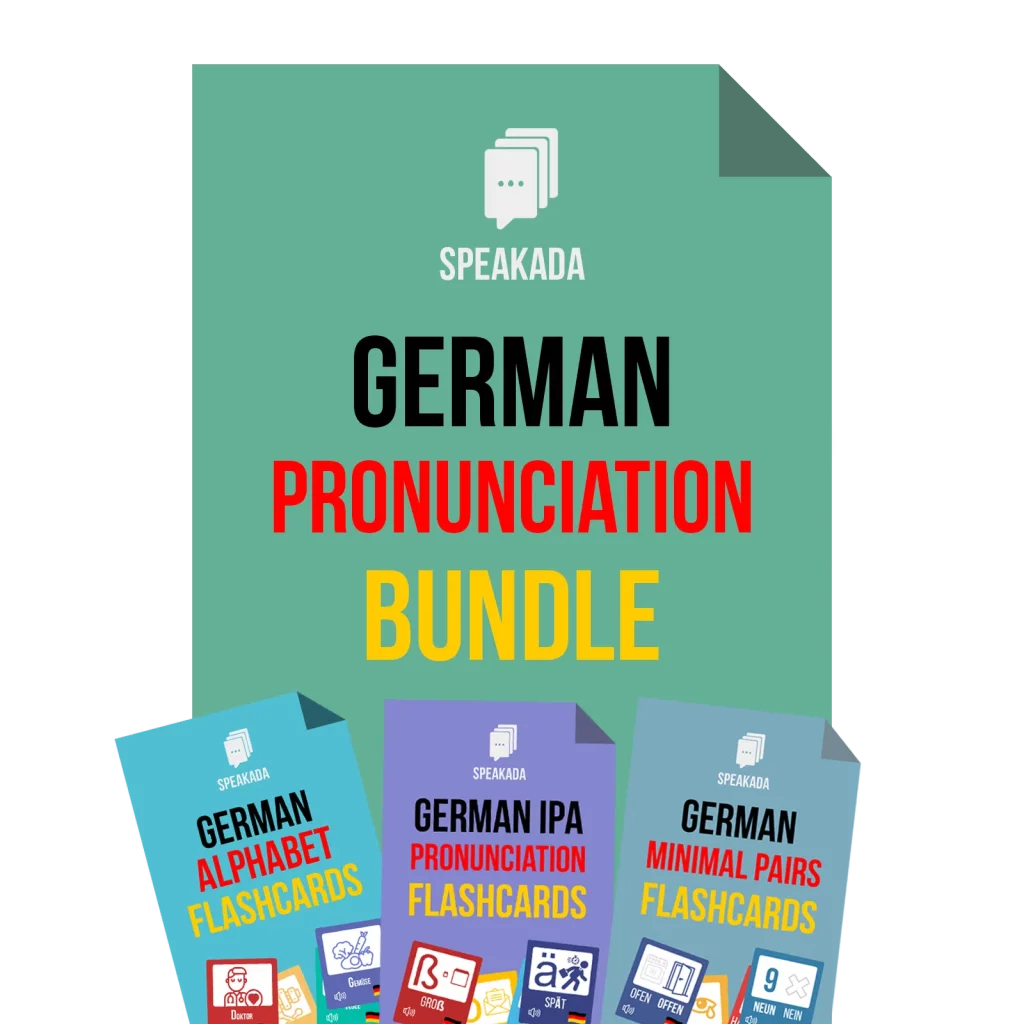
Our German Minimal Pairs Flashcards are built around this loop. The German Pronunciation Bundle adds the alphabet and IPA decks, so you can see the length and vowel quality on every word.
For the basics, our guide to how to pronounce German words is a good place to start.
How does German compare to Spanish and Italian?
Every language has a different hardest contrast. Italian’s is a doubled consonant, and our Italian sound analysis shows it in 118 of 222 pairs.
Spanish is gentler on the ear: most of its deck is made of pairs English hears easily, as we show in the hardest Spanish sounds for English speakers.
The bottom line
By our own deck data, German asks two things of an English ear: hear how long a sound is held, and hear a vowel made with the tongue forward and the lips rounded.
Both are skills your first language skipped. Both can be trained.
Want more practical, no-nonsense language-learning tips like this? Subscribe to Speakada Weekly for one practical email a week.