How to Use Anki for IELTS: The 2 Habits That Actually Raise Your Band
The short answer: if you do your IELTS Anki reviews daily but your band won’t move, the problem usually isn’t effort or card count - it’s how you review. Two habits fix it: (1) recall each word out loud in a sentence you could say in the Speaking test, instead of just recognizing the definition, and (2) prioritize the academic vocabulary and collocations that actually raise your Lexical Resource score, instead of drilling words you’ll never use. Neither means studying more. Both mean studying deliberately.
Why daily reviews aren’t enough
Plenty of committed test-takers keep a perfect Anki streak and still sit at the same band. The streak feels like progress, but two quiet habits drain most of the value out of every session - and on IELTS, where a quarter of your Speaking and Writing score is Lexical Resource, that gap shows up directly in your band.
Habit 1: Recall, don’t just recognize
The most common mistake is recognizing the word instead of recalling it. You flip the card, see significant, think “yeah, important,” and move on. But the examiner doesn’t reward words you can recognise - they reward words you can produce, accurately and in context. Recognition is a reading-test skill; retrieval is a Speaking-and-Writing skill.
This is one of the most replicated findings in learning science. Roediger and Karpicke found that people who tested themselves on material remembered far more a week later than people who simply re-read it the same number of times (Roediger & Karpicke, 2006, Psychological Science). Active retrieval - struggling to produce the answer - is what builds durable, usable memory.
Anki is a retrieval machine, but only if you use it as one. Before you flip an IELTS card, produce the word in a full sentence out loud - not just “significant = important,” but “There has been a significant increase in…” The IELTS payoff is collocation: examiners reward conduct research, a significant impact, play a crucial role - the natural word partners, not isolated synonyms. That half-second of “wait… how would I actually use this in Task 2?” is the entire point. If you can’t produce it in a sentence, that’s a card worth keeping close.
Habit 2: Prioritize your highest-value cards
The second habit is treating every card as equally important. If you have thousands of cards in default order, the academic words and collocations that raise your band can sit buried behind rare or topic-specific words you’ll almost never need on test day.
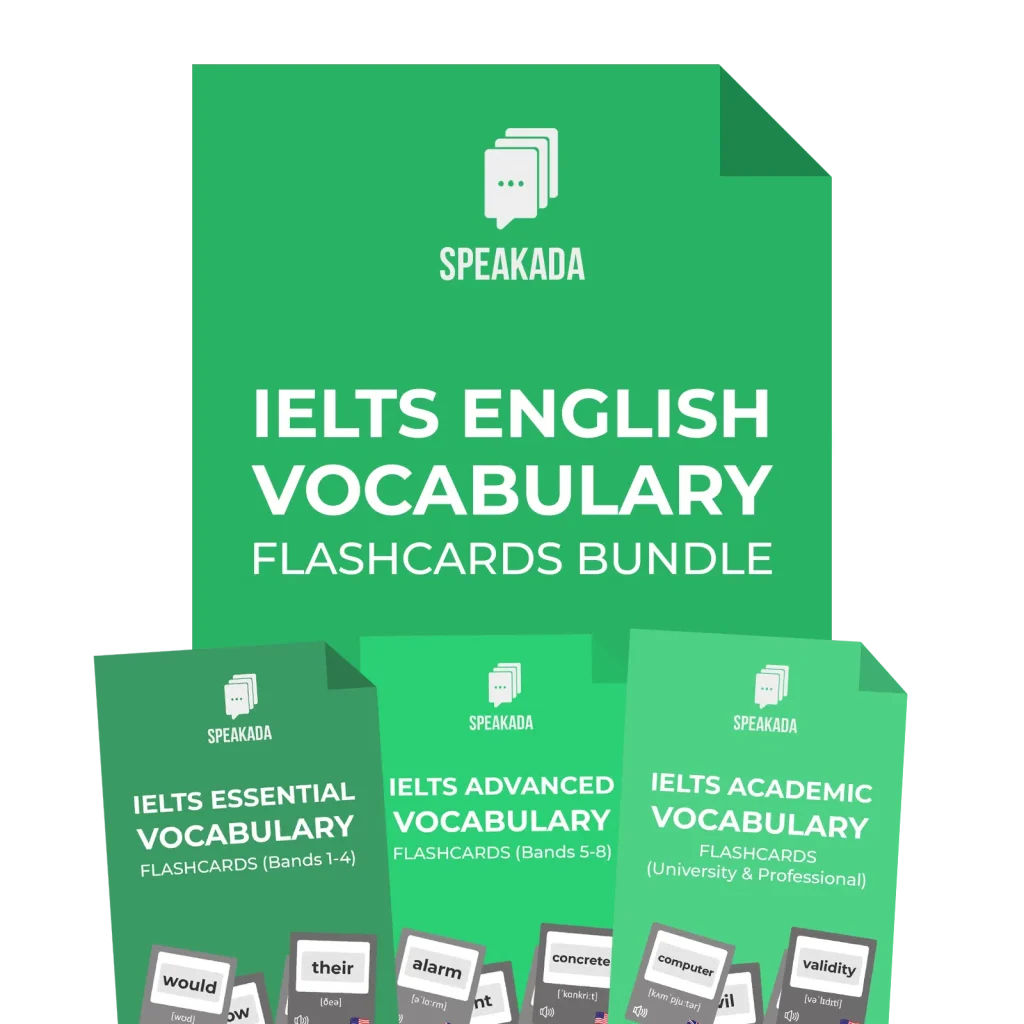
For IELTS, the highest-value cards are high-frequency academic vocabulary and the collocations that show up across Writing Task 2 and Speaking Part 3: cause/effect language, trend language for Task 1 (rise sharply, level off), and flexible band-7 verbs (highlight, address, demonstrate). Reorder your deck so these surface first and you’ll feel it in your practice answers within a couple of weeks - because the cards you see most become the cards that matter most. This pairs naturally with choosing the right material to begin with: a focused IELTS vocabulary bundle gives you the most band-relevant coverage per card, so prioritizing it compounds the effect.
How to do this in Anki (step by step)
- Recall first, in a sentence. Cover the answer, say the word inside a full IELTS-style sentence (with its natural collocation) then flip. Mark “Again” honestly when you could define it but couldn’t use it - that’s the gap that holds your band down.
- Reposition high-value cards. In the Browser, select the academic vocabulary and collocations tied to Writing Task 2 and Speaking Part 3, then Cards > Reposition to move them to the front of the new-card queue.
- Keep new cards modest and consistent. A steady daily number you can sustain beats big bursts you abandon before test day (see how many Anki cards per day for a sane range).
- Study in context. A card with a full example sentence (and audio) gives your brain something to retrieve toward - so you learn demonstrate inside the data demonstrate a clear trend, ready to drop into an essay, not as an isolated dictionary entry.
Not sure which deck to load first? See which Anki deck to start with for IELTS.
Common questions
Does active recall really work better than re-reading my IELTS word lists? Yes - the effect is well documented. Retrieval practice produces stronger long-term retention than re-studying the same material, even though re-reading often feels easier in the moment - and on IELTS, retrievable-in-a-sentence is exactly what the Speaking and Writing bands measure.
Should I memorise long lists of “advanced” words? No - the examiner rewards accurate, natural use, not rare words shoehorned in. A smaller set of high-frequency academic words and collocations you can actually use will move your band further than a long list you only recognise.
Will reordering my deck mess up the algorithm? No - repositioning only changes the order new cards are introduced. Your existing review schedule is untouched.
The takeaway
You don’t need more cards to get more from your IELTS Anki deck. You need to recall instead of recognize - in a full sentence, with the natural collocation - and prioritize the academic vocabulary that actually raises your band. Those two habits turn daily reviews into real IELTS progress.
Want one genuinely useful language-learning idea in your inbox each week? Join SPEAKADA WEEKLY - practical, science-based tips, no fluff.