German Top 2000 Words Flashcards
Learn the 2000 most common German words with sentence-based Anki flashcards. Reach ~90% comprehension of any German text, with high-quality audio, IPA, and all three gender colors.
LEARN TOP 2000 WORDS FOR 90% GERMAN COMPREHENSION
The German 2000 Words Flashcards are a digital Anki deck to help you learn the 2000 most common German words. Based on research by linguists Michael Lewis, Paul Nation, James Milton and Stephen Krashen, you will learn these 2000 top German words gradually in the context of real German sentences and basic German monolingual definitions.
After you learn the top 2000 words, you will be able to understand about 90% of any given text, according to the research findings of renowned linguist Paul Nation.
Also, when you master the top 2000 words, then you’ll be more likely to pass the A2 Beginner German Exam, according to linguist James Milton. This gives you a strong advantage to then pursue the Intermediate B levels of German.
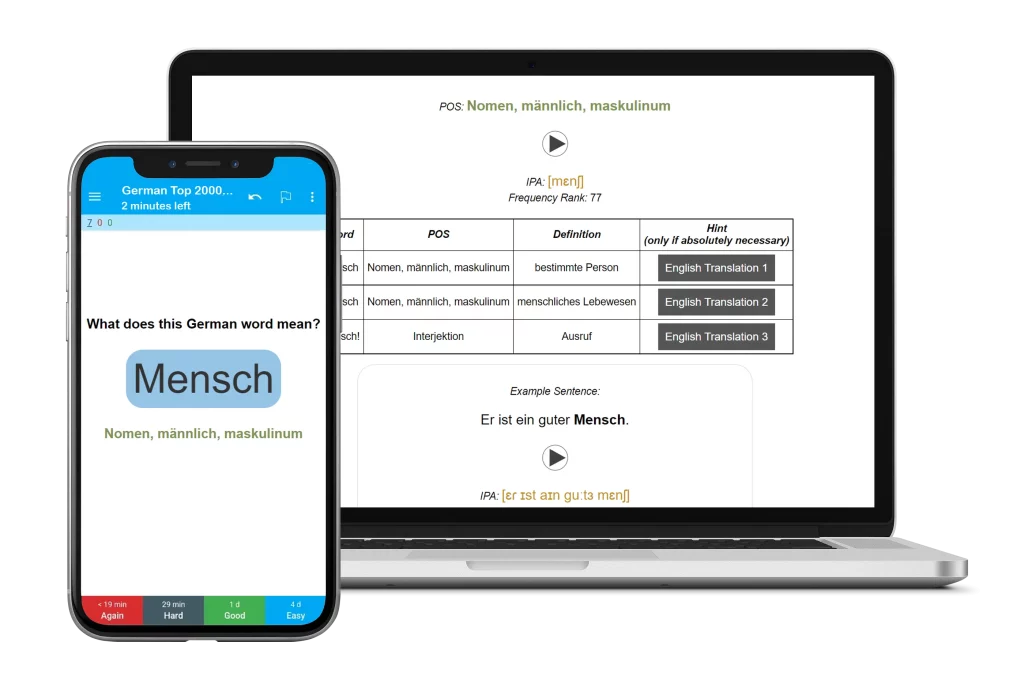
Language: German · Flashcards: 2,000 cards (2 variations per word) · Difficulty: Beginner–Intermediate · Time to Complete: 3–9 months
2 FLASHCARD TYPES FOR EACH OF THE 2000 GERMAN WORDS
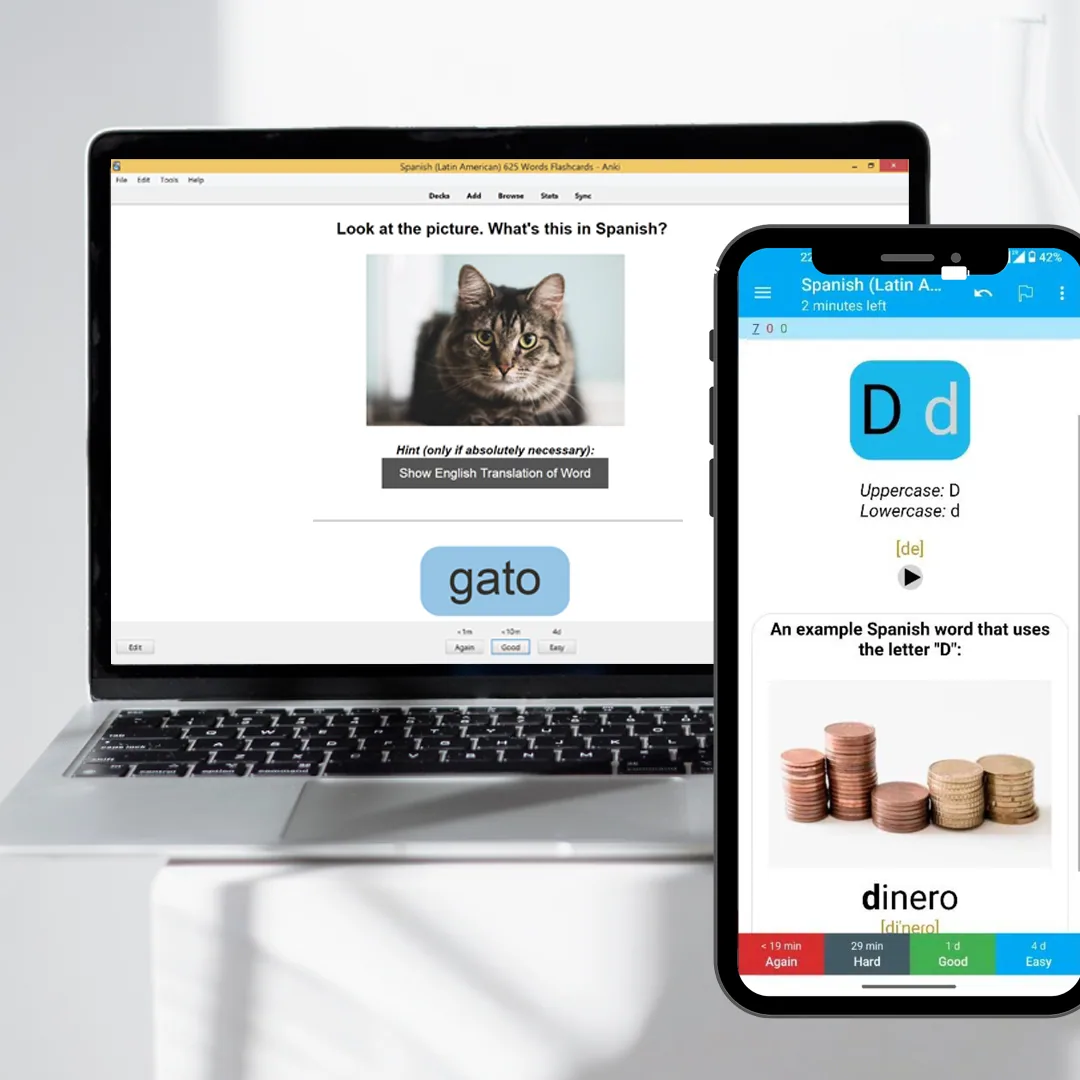
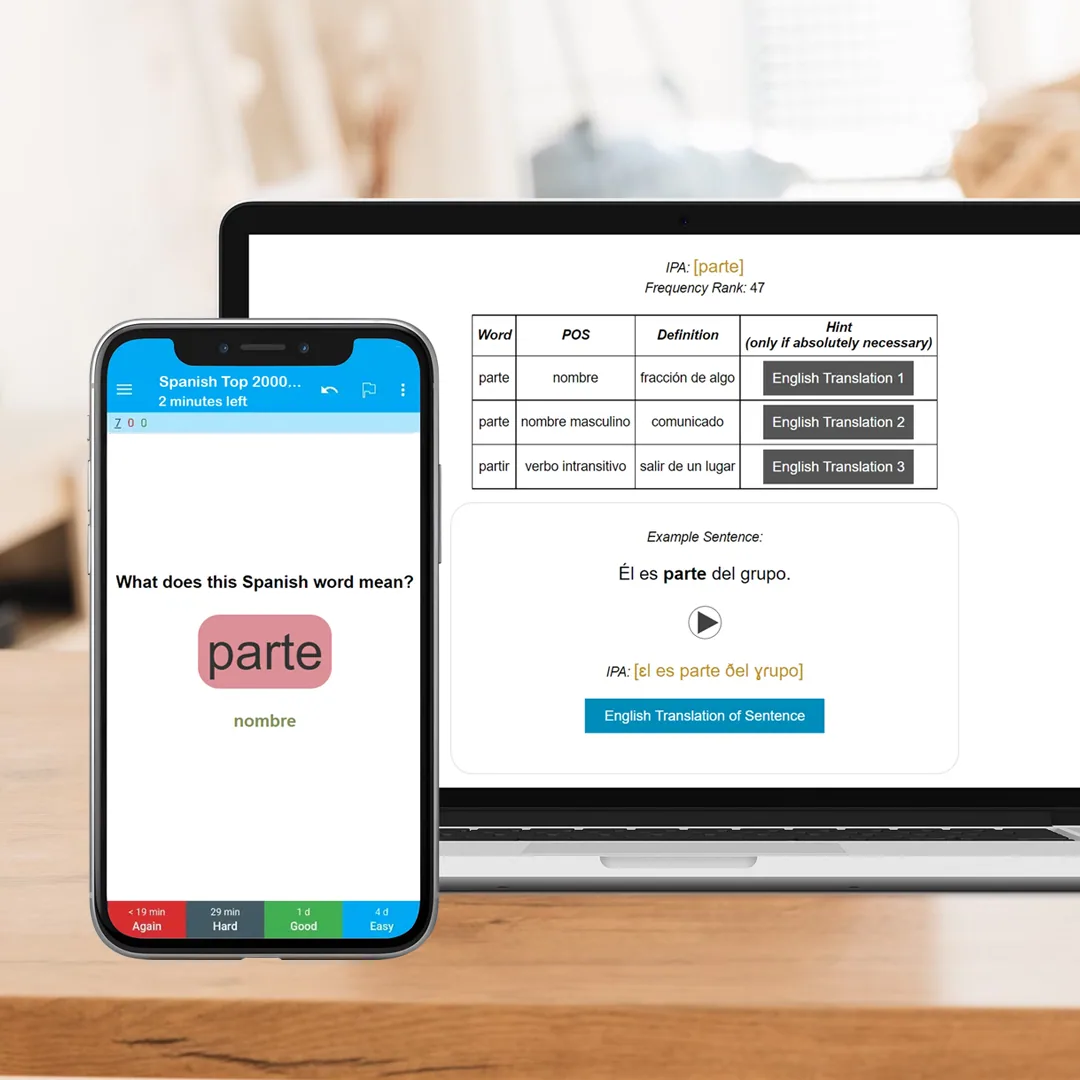
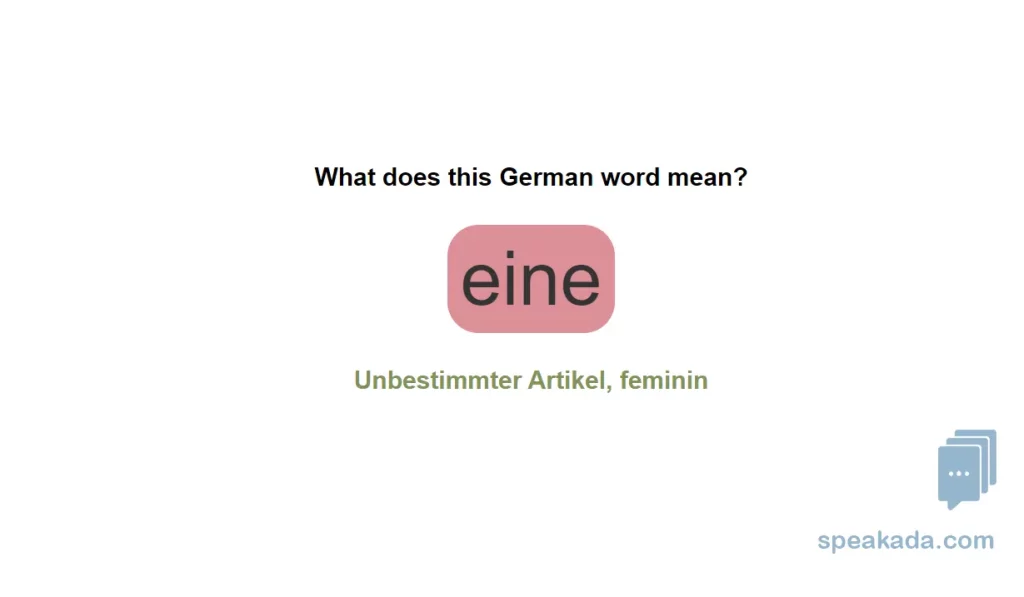
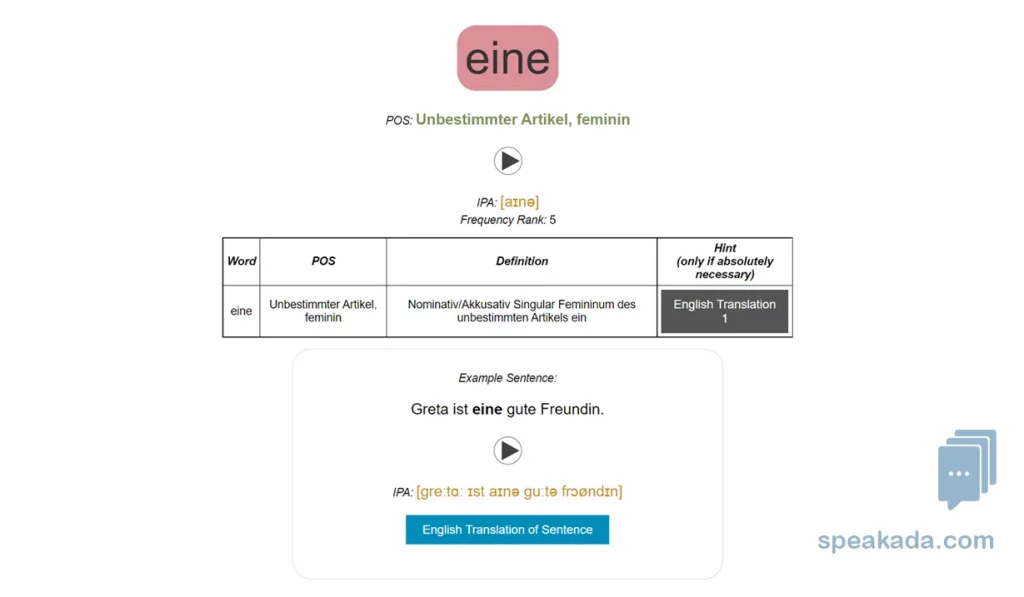
Below, you can see the Top 2000 German Words Trainer for Anki in action. There are 2 different flashcard variations for each word, which are randomly shown. The trainer’s flashcards include grammatical gender colors, Part of Speech (POS), IPA, Frequency rank, audio of the word, German monolingual definition, example sentence, and hidden hints of English translations when you need extra help.
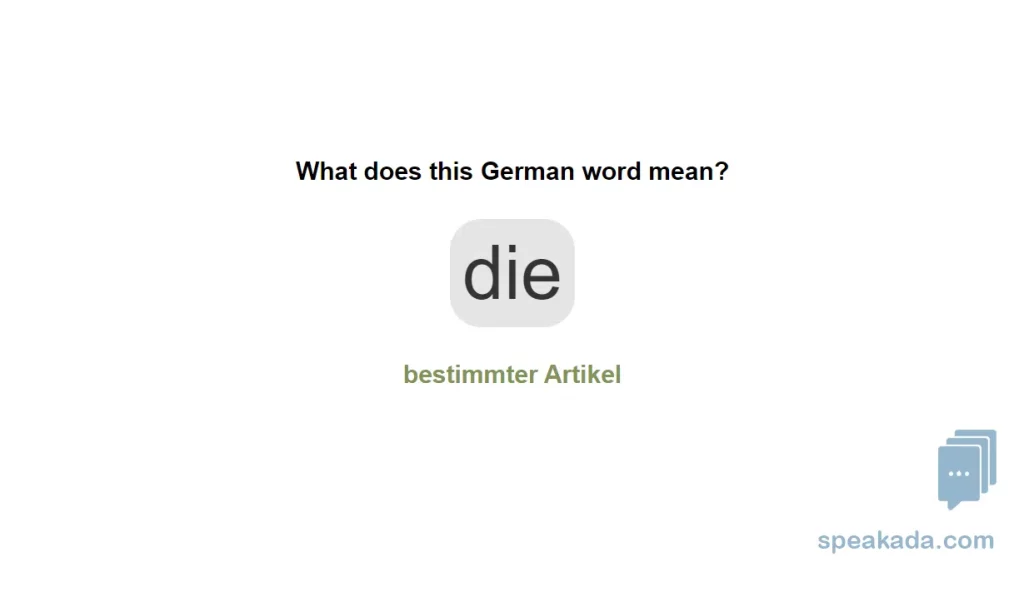
Front of Flashcard – Randomized Variation 1: “Word Comprehension”
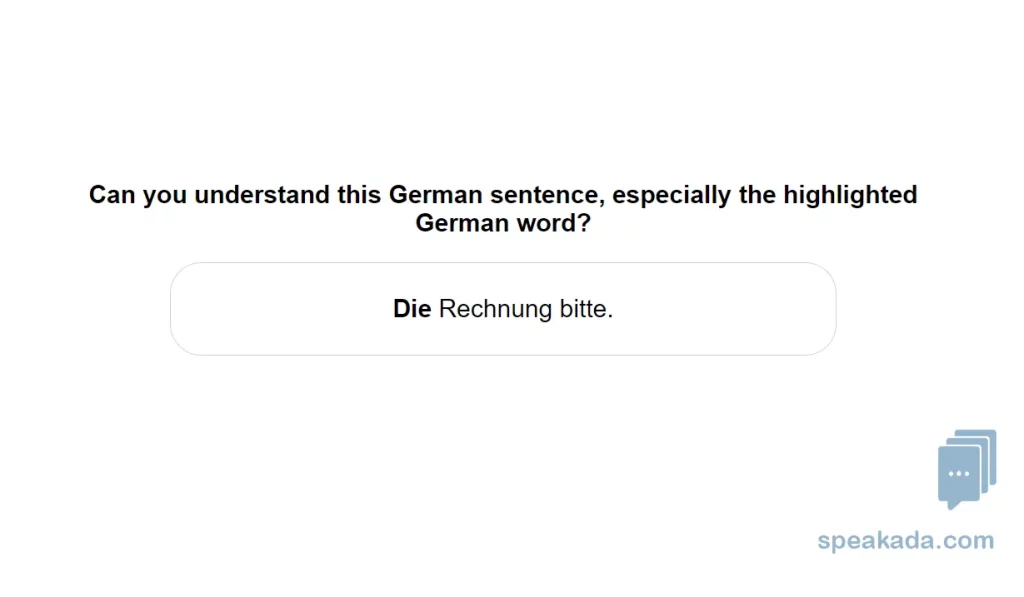
Front of Flashcard – Randomized Variation 2: “Sentence Comprehension”
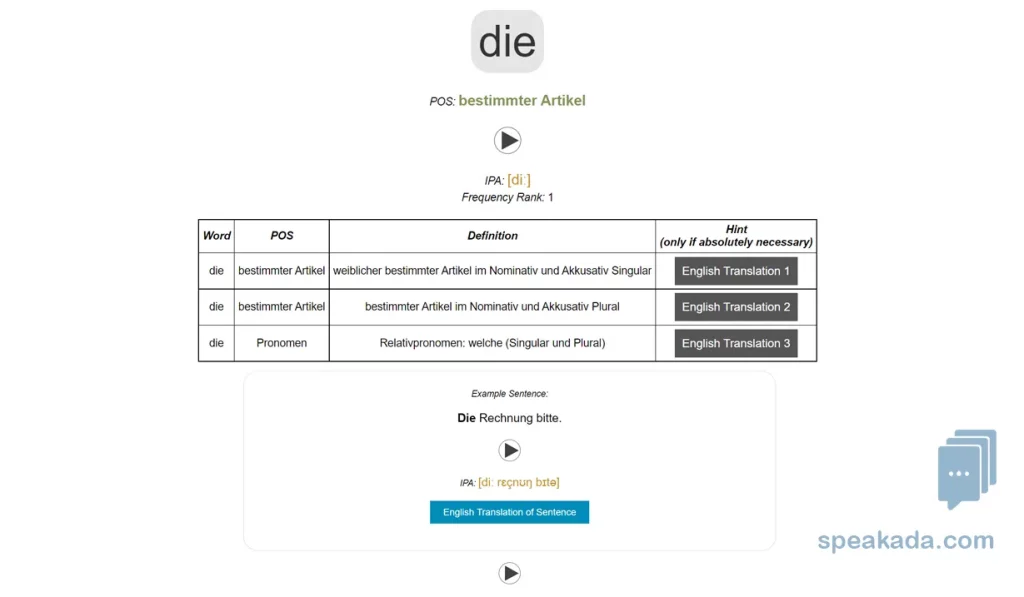
Back of Flashcard: Includes POS, IPA, Frequency Rank, German Definition, Example Sentence, hidden English translations
GET THE GERMAN TOP 2000 WORDS FLASHCARDS FOR ANKI ($185 ONLY)
GET 90% GERMAN COMPREHENSION WITH THE TOP 2000 WORDS
Research studies by linguists Professors Stuart Webb and Paul Nation have found that the top 2000 words account for 90% of the words used in general texts.
| Number of Words (Word Frequency) | Level of Comprehension |
|---|---|
| 1,000 words | ~75% comprehension of any text |
| 2,000 words | ~90% comprehension of any text |
| 6,000–7,000 words | ~98% comprehension of spoken material |
| 8,000–9,000 words | ~98% comprehension of written material |
“Word frequency” refers to how frequent or how often a given word is used in a certain language. In German there are hundreds of thousands of words you could learn. But when we analyze the frequency of those words in speech, books and other media, we realize that not every word has the same value for learning.
If you want to learn German faster, then you need to learn the words that are used most frequently in German. Paul Nation, a world-renowned vocabulary acquisition linguist researcher from Victoria University of Wellington, agrees with this. He emphasizes the need to use word frequency lists as guidelines to study vocabulary in a foreign language. If you learn about 2000 most frequently used words in a foreign language, then you’ll be able to understand 90% of the language as it is spoken in normal life, according to research. This is just one of several research studies that we use to determine which words to learn first and why.
REACH A2 CEFR LEVEL WITH ONLY 2000 WORDS
Linguist James Milton from Swansea University has done some interesting research to find out how many words are needed to pass certain levels of language tests based on the CEFR (Common European Framework Reference for Languages). The results are shown below:
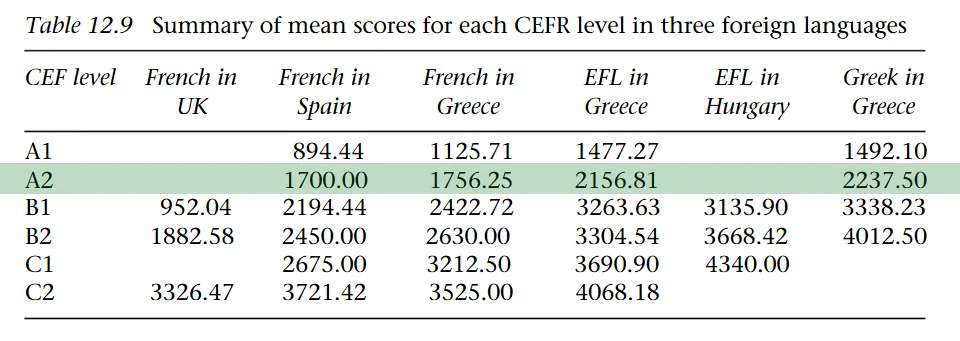
There, you can see that if you learn about the top 2000 words, you are likely to pass the A2 CEFR language exam. The “A” levels of the CEFR refer to the beginner stages of a language, so it’s evident that learning roughly the top 2000 words in a foreign language will clearly take you into the intermediate stages of the language. Our aim with the German Top 2000 Words Flashcards is to get you to A2 CEFR level. We therefore recommend learning the 2000 most common German words before learning additional words.
GET THE GERMAN TOP 2000 WORDS FLASHCARDS FOR ANKI ($185 ONLY)
BENEFITS OF THE GERMAN TOP 2000 WORDS TRAINER
Learn 2000 Most Common Words in German with Sentence Examples
Start learning the top 2000 German vocab, using sentence examples. There’s no need to rely on English translations so you can think in German faster. The Trainer includes a sentence example for every word, the audio of the new word, the IPA of the word, and a monolingual German definition of the word so that you start building more networks of associated German vocab in your mind.
Pronounce All German 2000 Words Correctly With Audios
Each flashcard contains an audio of the German word spoken to help you pronounce correctly the word in the right accent. The flashcard will also contain the IPA (International Phonetic Alphabet) of the word, along with the IPA of that full sentence to help you know the standard pronunciation.
Test Your Knowledge of German Vocabulary
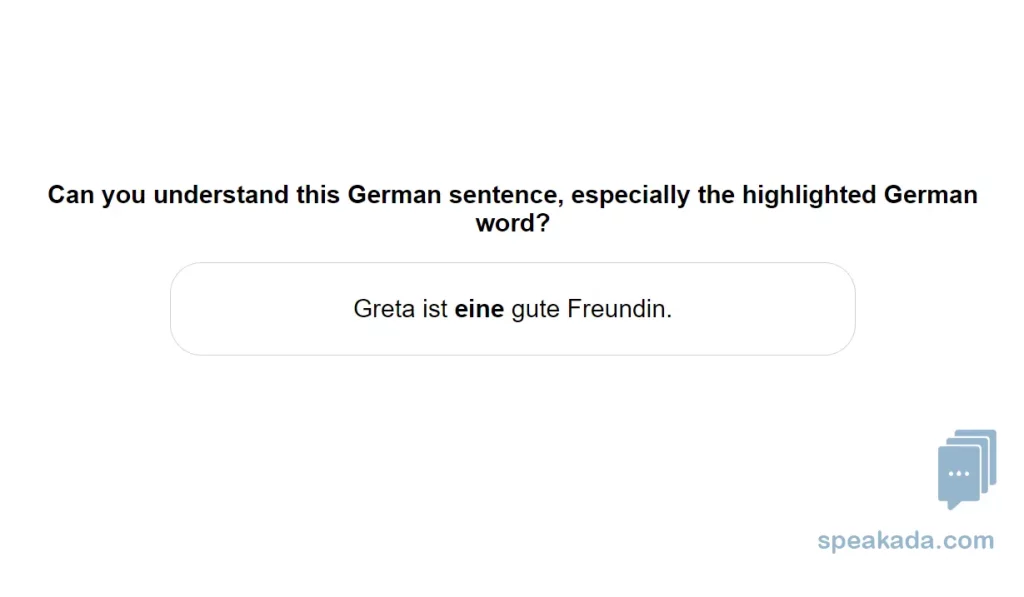
Use spaced repetition included in our German Vocab Anki deck so that you can regularly check your knowledge of words, and see how you’re progressing, and focus only on the most difficult words. By using the German Top 2000 Words Flashcards, you’ll reach 90% German comprehension.
BONUS: Remember All Three German Genders Easily with Colors
German has three grammatical genders, der (masculine), die (feminine), and das (neuter), and every noun must be learned with its correct article. This is one of the most challenging aspects of German for English speakers. That’s why we have color coded masculine (der) words as Blue, feminine (die) words as Red, and neuter (das) words as Gray. Your brain will associate the colors with the words, and therefore make it easier for you to remember all three genders. So you speak with more confidence.
GET THE GERMAN TOP 2000 WORDS FLASHCARDS FOR ANKI ($185 ONLY)
FREQUENTLY ASKED QUESTIONS
- Why are there no pictures for the Top 2000 Words Flashcards deck?
- What are the differences between the 500 Picture Words Flashcards and the Top 2000 Words Flashcards?
- Should I learn more than 2000 words?
WHY ARE THERE NO PICTURES FOR THE TOP 2000 WORDS DECK?
The German Top 2000 Words Flashcards use sentence-based cards and monolingual definitions as the main way for you to learn German. We do not include pictures in the Top 2000 Words Flashcards for 2 core reasons:
1. Think in German Using German-only Content
Firstly, we focus on German sentences and German definitions with the 2000 Words Flashcards because we believe that you need to eventually ease yourself into German-only content. If you already studied the picture-based 500 Picture Words flashcards, then it is certainly time for you to move on to actual German sentences. Eventually, you will want to read native German books and articles, as well as listen to native German broadcasts, conversations and music. These are all only in German, and all of the communication in them is mainly through sentences. Not random, individual words. So, we want to help you become familiar with German-only content, and that’s why our flashcards use German sentences.
We also provide you with German monolingual definitions for each of the flashcards. This means that if you have trouble understanding the meaning of the word in the sentence, then you can also read the basic German definition we provide. This helps you get familiar with synonyms, and builds a network of words in your brain that help to describe and reinforce newer ones. If you still have trouble, we also provide the English translation as a hidden hint, but you’re encouraged to first try and understand the German sentence on its own, along with the monolingual German definition.
Overall, we are trying to help you think in German. That’s why we now remove your reliance on pictures and the English language, because real life German content will often not give those to you.
2. Learn “Chunks” Based on Research From Linguists Michael Lewis & Stephen Krashen
Secondly, the Top 2000 Words Flashcards contain the exact words that are the most frequently used in German. So, this includes abstract words that are difficult to visualize and represent with a picture. We believe the best way to actually learn these abstract words is through understanding the meaning they provide in real German sentence “chunks”, as promoted by linguist Michael Lewis.
We have based these flashcards on research by linguists Michael Lewis and Stephen Krashen. Lewis emphasized that if you want to learn a language, then you need to understand sentence “chunks” of the language. It’s not enough to learn words on their own. Krashen’s “input hypothesis” states that learners progress in their knowledge of the language when they understand language input that is slightly more advanced than their current level. That is why you will focus on acquiring new German words in the context of real German sentences and basic German monolingual definitions.
GET THE GERMAN TOP 2000 WORDS FLASHCARDS FOR ANKI ($185 ONLY)
WHAT ARE THE DIFFERENCES BETWEEN THE 500 PICTURE WORDS AND TOP 2000 WORDS?
Although it is up to you whether you would like to use both the 500 Picture Words Flashcards and the Top 2000 Words Flashcards, there are a few things to consider before deciding whether you want to learn the 500 Picture Words first before learning the top 2000 German words. Other than the obvious difference of the number of words found in each deck, there are 2 main differences in the 500 Picture Words Flashcards and the Top 2000 Words Flashcards. The first is how the words are learned and the second is the source of the frequency list used. Below we’ll go into further detail of each difference.
1. Learning Using Picture-based Words Vs Sentence-based Words
You may be wondering why we offer 2 flashcard decks for German vocabulary: 1) Picture-Based 500 Picture Words Flashcards, and 2) Sentence-Based 2000 Words Flashcards.
The 500 Picture Words Flashcards are intended to be the first step to learning German vocabulary as it is picture-based and therefore easier to learn for beginners. It includes only words (verbs, nouns and adjectives) that are easily visually represented with an image. After you learn the 500 Picture Words, you will be able to think in very basic German and identify and say several words of objects and other things in the real world.
Whereas, the Top 2000 Words Flashcards are sentence-based and they are the next logical step for learning German vocabulary in the context of example sentences and monolingual definitions. We include a very simple yet useful sentence to learn each word. The sentence only contains the use of words found in the 500 Picture Words and the top 2000 words, making it easier to learn and a great way to transition to learning German grammar. This is also why learning the 500 Picture Words first would be useful. After learning the top 2000 words, you are estimated to reach the German A2 CEFR level, along with 90% comprehension of texts. You will be able to understand and produce German sentences to communicate with German speakers.
We recommend that you learn the German 500 Picture Words first if you are completely new to learning German, if you would like an easy transition to German vocabulary and to get the most out of this deck.
2. Differences with Frequency Lists Used and Where Words are Sourced
The second main difference between the 500 Picture Words Flashcards and the Top 2000 Words Flashcards is the frequency list used for each. It is important to note that the 500 Picture Words are inspired by the Fluent Forever word list, although we have made some tweaks and improvements where necessary. As the 500 Picture Words flashcards are picture-based, you’ll only find commonly used words that can be easily represented with a picture in this deck.
The top 2000 words on the other hand, are derived from a combination of the most popular corpora and comprehensive word frequency lists of the most common words in a language. These include, but are not limited to the following: the Corpus of Contemporary American English, British National Corpus, and the Routledge Frequency Dictionary series in various languages. We also use our own technology and proprietary process to scour millions of webpages, and billions of words in the target language to determine the frequency of words.
A few of the words found in the 500 Picture Words Flashcards do overlap but not all of them will be found in the Top 2000 Words Flashcards. The top 2000 words include both words that are abstract and words that can be easily represented with a picture. The top 2000 words will automatically be culturally and linguistically relevant for German because these are the popular words that actual German native speakers use.
GET THE GERMAN TOP 2000 WORDS FLASHCARDS FOR ANKI ($185 ONLY)
SHOULD I LEARN MORE THAN 2000 WORDS?
You can learn more than 2000 words, but you will get the highest yield on your effort with the first 2000 German words. Take a read of the linguistic research of Paul Nation and James Milton, and you’ll conclude that learning the top 2000 words gives you the best return on your effort. If you learn up to 7000 words, you only retain 8% more of the language as compared to learning 2000 words where you learn 90%. Also, you’ll take much longer to learn all 7000 words with smaller gains as compared to learning the top 2000 words. Once you start learning more than the top 2000 words, it will take much more of your time and you’ll be learning words that are less frequently used.
It’s clear that you need to master the 2000 most common German words first before learning rare vocabulary. For example, if you’re a beginner, you’re better off learning very common words like “go”, “want”, “have”, “food”, “house”, “mother” and “father” because you’re more likely to use these words in a range of contexts. If you haven’t mastered these words and other top 2000 words, then don’t waste time memorizing rarer words like “tumble”, “whisper”, “crawl”, “durian”, “mangosteen”, “great-grandmother” and “father-in-law”. It’s very unlikely that you’ll ever use these words as a beginner. So, please don’t spend any time on these rarer words, until you’ve mastered the first 2000 words, or unless these rarer words are so personally important to you and you absolutely need them.
Once you have completed learning the top 2000 words, we recommend learning words that you come across in media, literature and everyday life, rather than using a frequency list to add thousands of additional words. This will allow you to learn new words that are relevant to you. For example, if you are learning German for your career, you may want to add additional words that are commonly used in your work. But only do this once you’ve learned and mastered the top 2000 German words.
GET THE GERMAN TOP 2000 WORDS FLASHCARDS FOR ANKI ($185 ONLY)
TESTIMONIALS
Hear from the hundreds of language learners who use our Anki decks and love them!
“Speakada uses diverse methods of teaching and learning, from visual to vocal, which all makes it easy to learn.”

Roger
(International trade diplomat & Language learner)
“I’ve been able to tweak my pronunciation, reducing the mistakes I make & increasing my memory of new words.”
Carolina
(Corporate Tax Specialist & Language learner)
“Speakada motivates me by adapting to my schedule. I can learn in my own time. Now language learning is more fun.”
Eric
(Emergency medical doctor & Language learner)
“Thanks to Speakada I was able to save hours making flashcards and instead, focus on learning with confidence.”
Ines
(Business lawyer & Language learner)
🔒 Your Purchase Is Safe
All payments are processed securely via Stripe. If the product is significantly different from what’s described here, email us within 7 days for a refund.
GET THE GERMAN TOP 2000 WORDS FLASHCARDS FOR ANKI ($185 ONLY)